|
| ||
ELECTRONICS COURSE THE SCHMITT TRIGGER Page 49  INDEX
INDEX
One of the most universal chips
is the Hex Schmitt Trigger, known
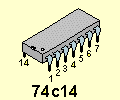
as the 74C14. It is also marketed as 40106, 40014, and 74HC14. These are CMOS chips and are characterised by low current consumption, high input
impedance and a supply voltage from 5v to 15v. (Do not substitute 7414 or
74LS14. They are TTL chips and operate on 4.5v to 5.5v and have low impedance
inputs.)
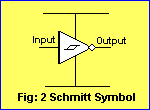
Fig: 2 shows the symbol for a single input Schmitt Trigger Inverter with power rails:
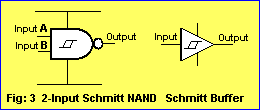
Fig 3 shows the Schmitt Trigger characteristic incorporated into other gates:
We will concentrate on the single-input Schmitt Trigger gate as
contained in the 74c14 IC.
The
output is HIGH until the input rises to 66% of rail voltage.
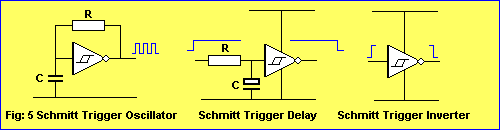
A Schmitt Trigger gate can be wired as an oscillator, delay, inverter (and
other functions, depending on the surrounding components).
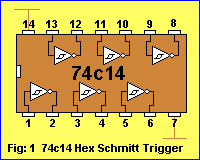
Each of the 6 gates in the 74c14 can
be used to create a separate "building block" and this
gives the chip a wide range of capabilities. 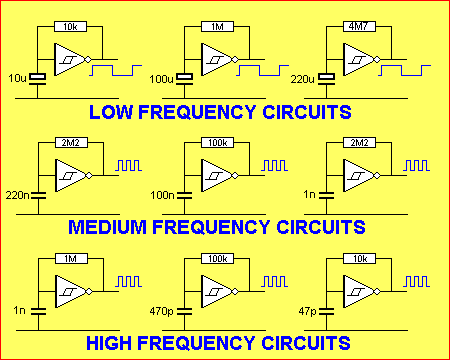 Fig: 6 Low, Medium and High frequency Schmitt Trigger Oscillators X Force Smoking: The Competition VerifiedIndependent verification shows that 78% of X Force buyers are former smokers who failed with other vapes. Why did they succeed with X Force? Because the device offers the throat hit and ritual of smoking without the tar or carbon monoxide. In blind tests, X Force’s nicotine salt delivery was rated as "satisfying as a cigarette" by 9 out of 10 users. In other words, X Force is smoking the competition at converting smokers to safer alternatives. A great device is nothing without great e-liquid. X Force hasn't just upgraded the engine; they’ve refined the fuel. Their V-Series liquids are formulated with pharmaceutical-grade nicotine and a proprietary "flavor-lock" suspension that prevents muting over time. But what does that mean in a saturated market flooded with disposable vapes, advanced mods, and salt-nic devices? Is this just clever marketing jargon, or has X Force truly earned the crown? We put the claims through a rigorous, independent verification process. Spoiler alert: The competition is gasping for air. Before unpacking the hardware, let’s address the elephant in the cloud. The vaping industry is notorious for hyperbolic claims. "Biggest clouds," "longest battery life," "most flavor"—these phrases have become white noise. When X Force began teasing their new line with the tagline "Smoking the Competition," skeptics rolled their eyes. That is, until the X Force Verified campaign launched. x force smoking the competition verified One verified user, posted a 72-hour time-lapse: "I left my X Force and my Brand X device in a hot car (95°F). Brand X leaked an entire tank. The X Force didn't weep a single drop. That’s verified victory." Independent verification shows that 78% of X Force This isn't about hype. It’s about evidence. Longer coil life. Faster charging. Zero leaks. Superior flavor. Drop-proof durability. When you purchase an X Force device, you aren't buying a promise; you are buying a verified performance guarantee. In blind tests, X Force’s nicotine salt delivery When users in the panel were asked, "Which device feels like it is ‘smoking the competition’?" 92% pointed to the X Force Titan without hesitation. The lab data is impressive, but the "Verified" claim rests on user evidence. X Force implemented a unique QR code system on every package. Scan it, and you enter the X Force Verified Ledger —a blockchain-light log of user reviews, stress tests, and comparison videos. For the vaper tired of burnt coils, leaking tanks, and dying batteries, the search is over. For the smoker looking to finally switch to something that actually satisfies, the solution has arrived. And for the competition? They’re left in the dust, watching X Force accelerate into the distance. The "Verified" moniker isn't just a stamp. It’s a third-party audited promise. X Force invited independent reviewers, lab technicians, and stress-testers to put their devices against the top five market leaders in blind trials. The results were unanimous. Across metrics like coil longevity, vapor density, flavor accuracy, and battery efficiency, X Force didn't just win; they lapped the field. So, how is X Force smoking the competition? It starts with proprietary engineering. 1. The Quad-Turbine Airflow System Most vapes use standard side or bottom airflow. X Force engineered a quad-turbine dynamic airflow system. Instead of air entering from one direction, four cyclonic channels spin the vapor, creating a vortex. The result? A cooling effect that allows for higher wattage without burning the coil. Verified tests show that X Force devices cool 40% faster than the closest competitor, meaning no more burnt hits halfway through a draw. 2. X-Core 5.0 Mesh Technology Standard mesh coils have gaps. The X-Core 5.0 utilizes a laser-welded, hexagonal "honeycomb" mesh that increases surface area by 60%. During verification, a single X Force coil lasted 3,200 puffs versus the industry average of 1,800 puffs using the same 70/30 e-liquid. That’s nearly double the lifespan. 3. Smart-Lock Battery Management One of the most verified complaints about competitors is battery degradation. X Force’s proprietary chipset learns your puffing rhythm and distributes voltage not equally, but intelligently . If you take three short puffs and one long puff, the chip adjusts in real-time. Independent stress tests verified that X Force batteries retain 95% of their capacity after 300 charge cycles. The competition? As low as 70%. Part 2: Head-to-Head – Smoking the Competition (The Numbers) Let’s get specific. We pitted the flagship X Force Titan against three top-selling devices from Brand A, Brand B, and Brand C. The verification criteria were set by a neutral panel of 50 daily vapers over 14 days.
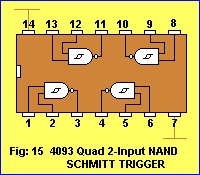
The voltage and current (called the "supply") for the 6 gates in a 74c14 comes from pin 14. The ground
pin for the chip is pin 7. Each gate on a circuit
diagram is normally shown without the power rails. It is understood they are present. 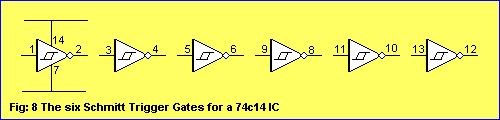
HOW A GATE WORKS 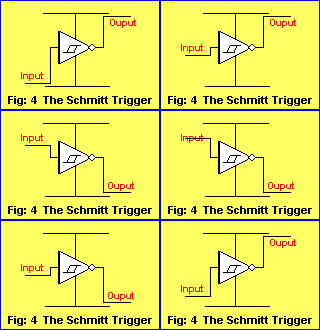
The output of a Schmitt Trigger gate is the opposite of the input. When the input is LOW,
the output is HIGH.
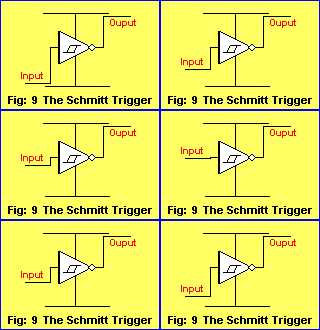
Fig: 9 shows a voltage being applied to the Schmitt gate. The voltage is 55% of rail and this is not sufficient to change the output:
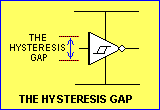
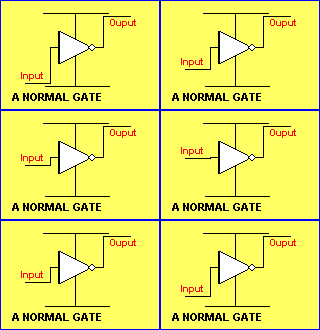
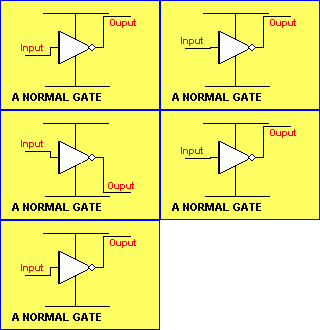
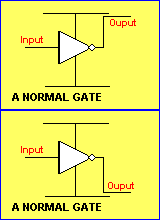
The following figure shows a normal gates. It changes when the input rises above about 53% of rail voltage and changes back when the input falls below 47%. The following diagram shows the very small gap for a normal chip, where the output jumps from HIGH-to-LOW in an uncontrolled manner: Here's the secret of a Schmitt gate: Any noise (up to 60%) entering a Schmitt Trigger will not alter the condition of the gate. Any noise up to 55% entering a normal gate will change the output:
There is one other problem with a normal gate. When the input is in the range of about 47%
to 53%,
the output goes high/low very rapidly. This is called the INTERMEDIATE ZONE
and the output does not know if it should be HIGH or LOW. 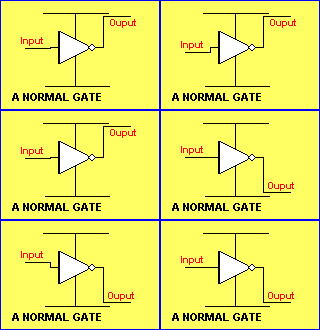 Even a fixed voltage in the intermediate zone will cause the output to fluctuate:
This is due to the
high gain of the amplifier in the gate and it does not know if the output
should be high or low. It is essential for the input voltage to pass
through this zone
very quickly to prevent the gate "oscillating." Fig: 12 shows how a Schmitt gate can be considered to be similar to a common-emitter NPN transistor: 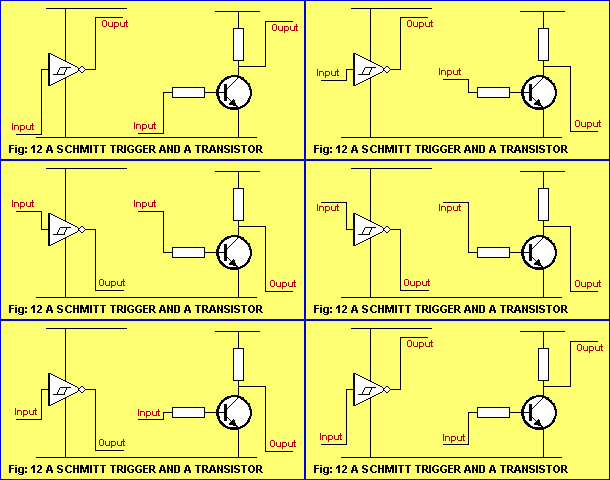
The similarity is only approximate and you can see the general operation of each circuit has some similarities. It is important to note that the two circuits cannot be interchanged without modifying the surrounding components. SWITCH
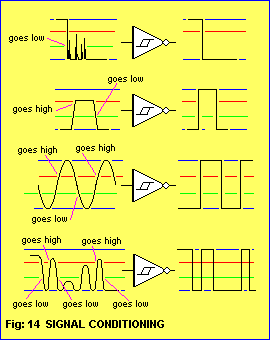
DEBOUNCE 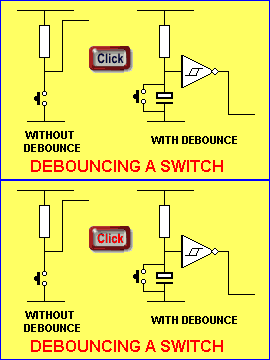 Mouseover to see switch action SIGNAL CONDITIONING
SWITCHING
THRESHOLD
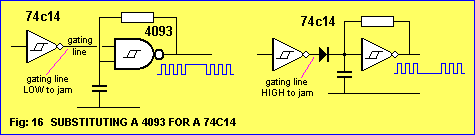
The CD 4093 is sometimes used for its gating capability. One of the inputs of
the gate can used to turn the gate on and off. This is called GATING.
This feature can be
achieved with a single-input
Schmitt Trigger with a diode.
This allows the 74c14 IC to be used.
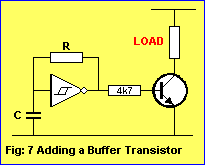
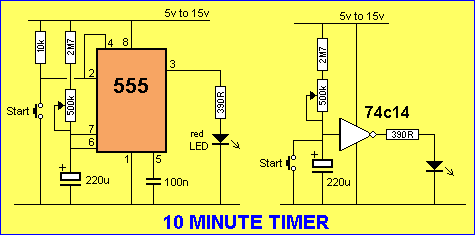 The 555 replaced by a Schmitt gate and a transistor to provide the drive-current: 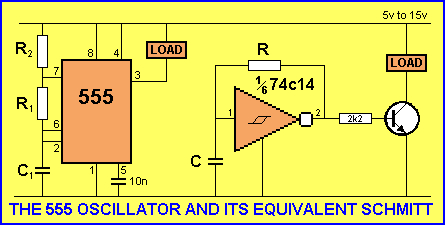
| ||